
Mister Crypto
- Role
- Freelance developer (end-to-end)
- Context
- Private platform for an active crypto trading community
- Tools
- Next.js
- Supabase
- shadcn/ui
- Tailwind CSS
- Vercel
- Timing
- March 2025
Overview
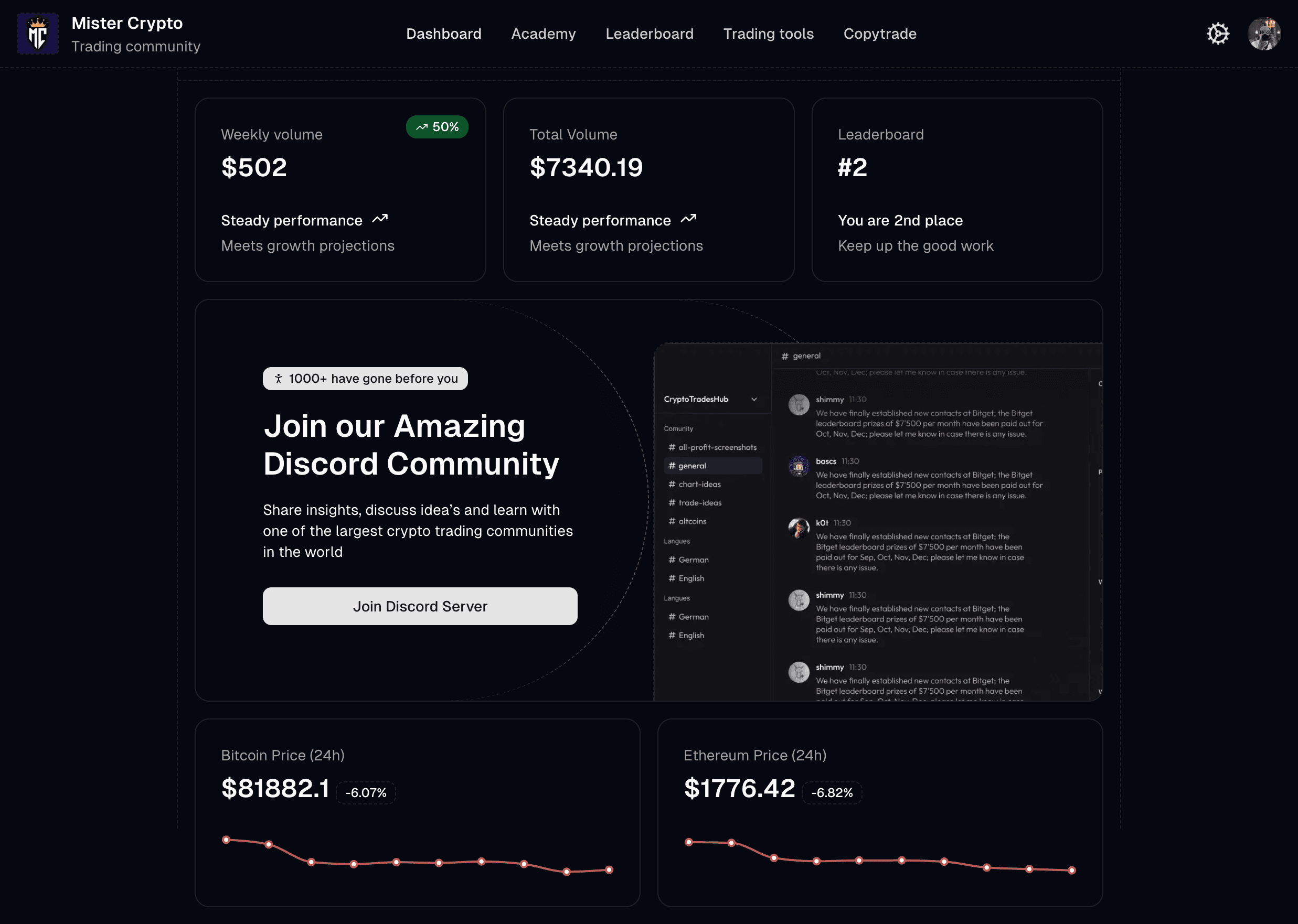
Mister Crypto is a private platform built for an active crypto trading community. The platform handles onboarding through a landing page and Discord verification, and provides verified users access to a private dashboard with real-time tools and insights.
The project was delivered as an end-to-end freelance assignment, with full responsibility for design, development, and delivery.
Context
The client needed a fast, production-ready MVP that could be used immediately by a live community. Requirements evolved during development, feedback loops were short, and the platform had to remain stable while actively used.
All communication and iteration happened directly via Discord.
Scope & role
I owned the full product lifecycle:
- product and interface design
- frontend and backend development
- exchange and external API integrations
- access control and verification flows
- deployment and iteration
There was no separate team or formal process. Planning, prioritization, and quality control were handled independently.
Platform features
The platform consists of:
- a landing page funnel for onboarding
- Discord-based user verification
- a private dashboard with trading signals, leaderboards, copy-trading insights, and an academy
- real-time statistics and visual progress indicators
- full mobile support
To support real trading workflows, the platform integrates directly with crypto exchanges Blofin and Weex.

Technical approach
Access and data flow
The system was built with a focus on maintainability and fast iteration:
- Next.js for the application layer
- Supabase for authentication, database, and real-time data
- shadcn/ui with Tailwind CSS for a consistent UI system
This setup allowed frequent changes without destabilizing the codebase.
Iteration & feedback
Early versions of the dashboard exposed too much technical detail. Based on direct feedback from both the client and community, the interface was simplified by improving hierarchy, language, and visual structure.
Changes were reviewed and shipped continuously, keeping feedback loops short and decisions concrete.
Outcome
A platform in continuous use by a live trading community, delivered and iterated by a single engineer working directly with stakeholders, with the architecture trimmed to what the product actually needed.
The project is a small case study in operating under real constraints: limited time, evolving requirements, and active users who notice every regression.