


Machine Monitoring Platform
- Role
- Technical lead (student team project)
- Context
- Industrial machine monitoring platform
- Team
- 5 engineers
- Timing
- Sep 2024 - Jan 2025 (before later commercial collaboration)
Context
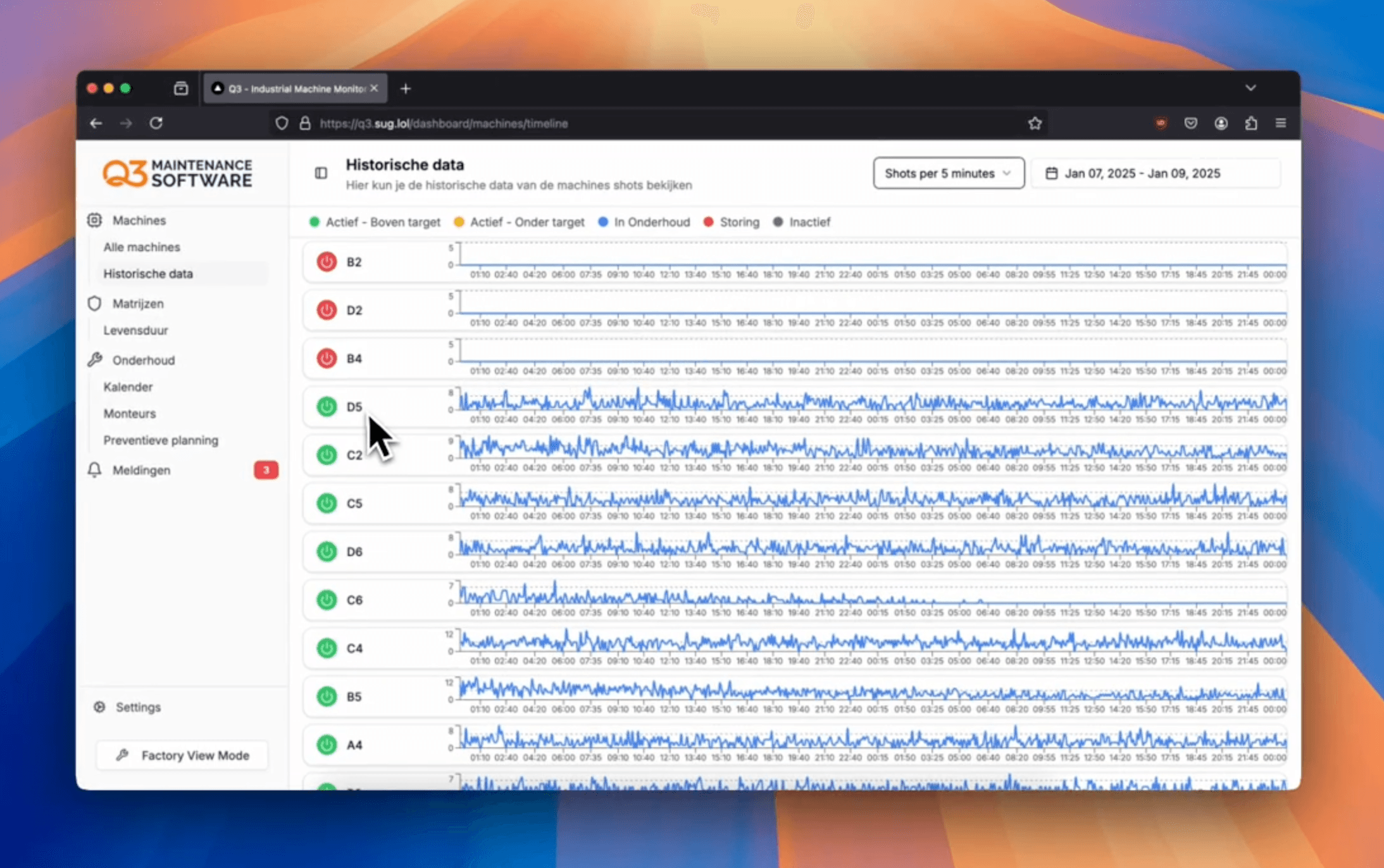
As part of a school project, I worked with Q3 Concept B.V. on an early version of a machine monitoring platform. The goal was to explore how real-time production data from machines and molds could be structured and visualized in a way that was useful for operators and managers.
I led the technical direction of a five-person team and acted as the primary point of contact on architecture and implementation decisions.
The problem
Even at an early stage, the constraints were very real:
- Multiple machines producing continuous data
- Complex relationships between machines, molds, and production runs
- A need for live insight, not static reports
- A codebase that needed to stay understandable for a team, not just one developer
The challenge was not building "a dashboard", but designing a system that could grow without collapsing under its own complexity.
My role as technical lead
As tech lead, my responsibilities included:
- Designing the initial data model for machines, molds, and production metrics
- Defining how real-time data should flow through the system
- Making architectural decisions that balanced speed and maintainability
- Reviewing and guiding implementation work across the team
While this was a collaborative effort, I was responsible for keeping one clear technical direction across the project.
Key technical decisions
Using PostgreSQL views to reduce complexity
Rather than exposing raw tables directly to the application, PostgreSQL views were used to present clean, purpose-driven representations of industrial data.
This allowed the team to:
- build dashboards without duplicating business logic
- understand production metrics more easily
- change underlying schemas without breaking the UI
Real-time monitoring where it mattered
Supabase's real-time features were applied to machine status and alerts, enabling live feedback without overloading the system with unnecessary subscriptions.
The focus was signal over noise.
Tradeoff: views stay readable but can hide expensive queries; we relied on indexes and kept subscriptions scoped to what each role needed.
Authentication and access patterns
Supabase's built-in authentication supported different user roles (operators vs. managers) without introducing additional infrastructure, keeping the system simple and coherent.
RLS note: policies were scoped by role/org patterns in the data model. Not every edge case was production-hardened (academic scope), but the boundary between desktop operator views and manager summaries was explicit in the schema discussion.
What the platform delivered
- Live visibility into machine and mold status
- Production dashboards with actionable metrics
- A scalable data structure suitable for industrial workloads
- A responsive interface accessible on desktop and mobile
"Keke is a great developer. He enjoys helping others and demonstrated excellent teamwork during our collaboration at Fontys."
"Keke is a good developer. In group settings, he works very well together and ensures everyone learns from each other."
What I took from this project
This project was formative for how I approach production software:
- Data modeling decisions compound quickly
- Real-time systems demand restraint, not just speed
- Tech leadership is as much about reducing confusion as writing code
Many of these lessons carried directly into later work, including WorkOrder, where reliability and day-to-day operations matter even more.
Why this project still belongs here
Although this was a school project, it involved:
- a real company
- real-world constraints
- and real technical trade-offs
Leading the technical direction of a team in this context was an early but important step in how I now work as a founding engineer.
This project predates later commercial work with Q3 and was completed in an academic context.